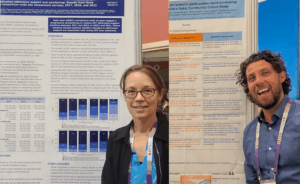
CUNY ISPH investigators, Denis Nash, Ellen Brazier, and Phil Kreniske attended the International AIDS Society (IAS) Conference in Kigali, Rwanda.
Ellen Brazier presented a poster on trends in real-world clinic practices related to routine adherence support and monitoring for adults with HIV. This study used serial cross-sectional surveys conducted by the International epidemiology Databases to Evaluate AIDS (IeDEA) among HIV clinics in 43 countries in 2017 (n=206), 2020 (n=200) and 2023 (n=214), with all three surveys completed by 131 clinics. The study found that clinics in low/middle-income countries (LMICs) were generally better resourced in terms of staffing for adherence support, compared with clinics in high-income countries (HICs). Clinics in LMICs also reported offering a broader range of adherence support interventions—from individualized counseling, group counseling and peer support groups to adherence aids and reminder devices—than those in HICs. At the same time, clinics in LMICs reported persistent gaps in viral load testing capacity, with less than half reporting on-site VL testing in 2023 and more than one-third reporting turn-around times of two weeks or more for VL test results.
Using composite measures of the level or intensity of routine adherence support and monitoring, the study found that HIV clinics in LMICs generally provided more intensive adherence support and monitoring than those in HIC countries. In both settings, however, routine provision of intensive adherence support to all patients decreased over time—changes that may reflect the adoption and scale up of differentiated service delivery (i.e., namely the provision of client-centered care, tailored to the preferences and needs of individuals served, as opposed to “one-size fits all” models of HIV care). In view of the reported streamlining of ART adherence support and increasing focus of this support on eligible patients, further research should examine how evolving clinic adherence support practices are associated with care retention and virologic suppression outcomes.
Phil Kreniske presented key findings on adolescent research participation from the ICARE study (R01MH134695), which he leads in Rakai, Uganda. This work, building on a long-standing collaboration with Dr. John Santelli of Columbia University, tackles a critical paradox in global health: while adolescents in many countries can consent to their own sexual and reproductive healthcare, they often require parental permission to participate in research.
This requirement has become one of the largest obstacles to including adolescents in studies, creating a significant knowledge gap, particularly in low- and middle-income countries. The consequences are profound. Biomedical tools like pre-exposure prophylaxis (PrEP) are highly effective in preventing HIV in adults, but their potential for young people remains under-explored. Despite youth in East and Southern Africa facing the highest incidence of new HIV infections, less than 1% of prevention trials have included minors. This systematic exclusion of adolescents directly contributes to age-related disparities in health outcomes.
Dr. Kreniske’s poster explored the complexities of who should make the final decision about an adolescent’s research participation. The findings emphasize an urgent need for policies that prioritize adolescent autonomy while maintaining appropriate safeguards. Such policies are essential to ensure the inclusion of adolescents in biomedical trials and to advance life-saving HIV prevention efforts.
In addition to his leadership on the ICARE study, Dr. Kreniske’s collaborative work was featured in several other presentations. He contributed to two posters for the Rakai Orphans in Communities (ROC: R01HD112241) study, led by Dr. Santelli. While one poster detailed the remarkable success of PEPFAR in reducing HIV-related orphanhood, the second highlighted that orphans remain a key vulnerable group for HIV acquisition. The findings underscore the ongoing need for targeted HIV prevention, PrEP access, and social support programs focused on education and family strengthening for these youth. He served as senior author on a systematic review led by Dr. Kirsty Sievwright (Sacred Heart University). The review identified the prevalence and determinants of suicidality among young people affected by HIV, highlighting a consistent link between depression and suicidality. The findings point to an urgent need for tailored mental health interventions, especially in low- and middle-income countries where the majority of youth living with or affected by HIV reside.